Lists and while loops
- Create a memory diagram for the following code listing.
    def check_quiz(responses: list[bool]) -> int:
        answer_key: list[bool] = [True, True, False]
        correct: int = 0
        idx: int = 0
        while idx < len(responses):
            if responses[idx] == answer_key[idx]:
                correct += 1
                idx += 1
            else:
                idx += 1
        return correct

    def main() -> None:
        my_quiz: list[bool] = [True, True, True]
        grade: int = check_quiz(my_quiz)
        print(f"{grade} out of 3 questions correct.")


main()- Create a memory diagram for the following code listing.
    """Practice diagram."""

    def create() -> list[int]:
        """An obnoxious way to make a list."""
        list_1: list[int] = []
        i: int = 0
        while i < 3:
            list_1.append(i)
            i += 1
        return list_1


    def increase(a_list: list[int], x: int) -> None:
        """Lets pump it up!"""
        i: int = 0
        while i < len(a_list):
            a_list[i] += x
            i += 1
        return None


    def main() -> None:
        """Entrypoint of the program."""
        list_1: list[int] = create()
        list_2: list[int] = list_1
        list_1 = create()
        increase(list_1, 2)
        print(list_1)
        print(list_2)


main()- Create a memory diagram for the following code listing.
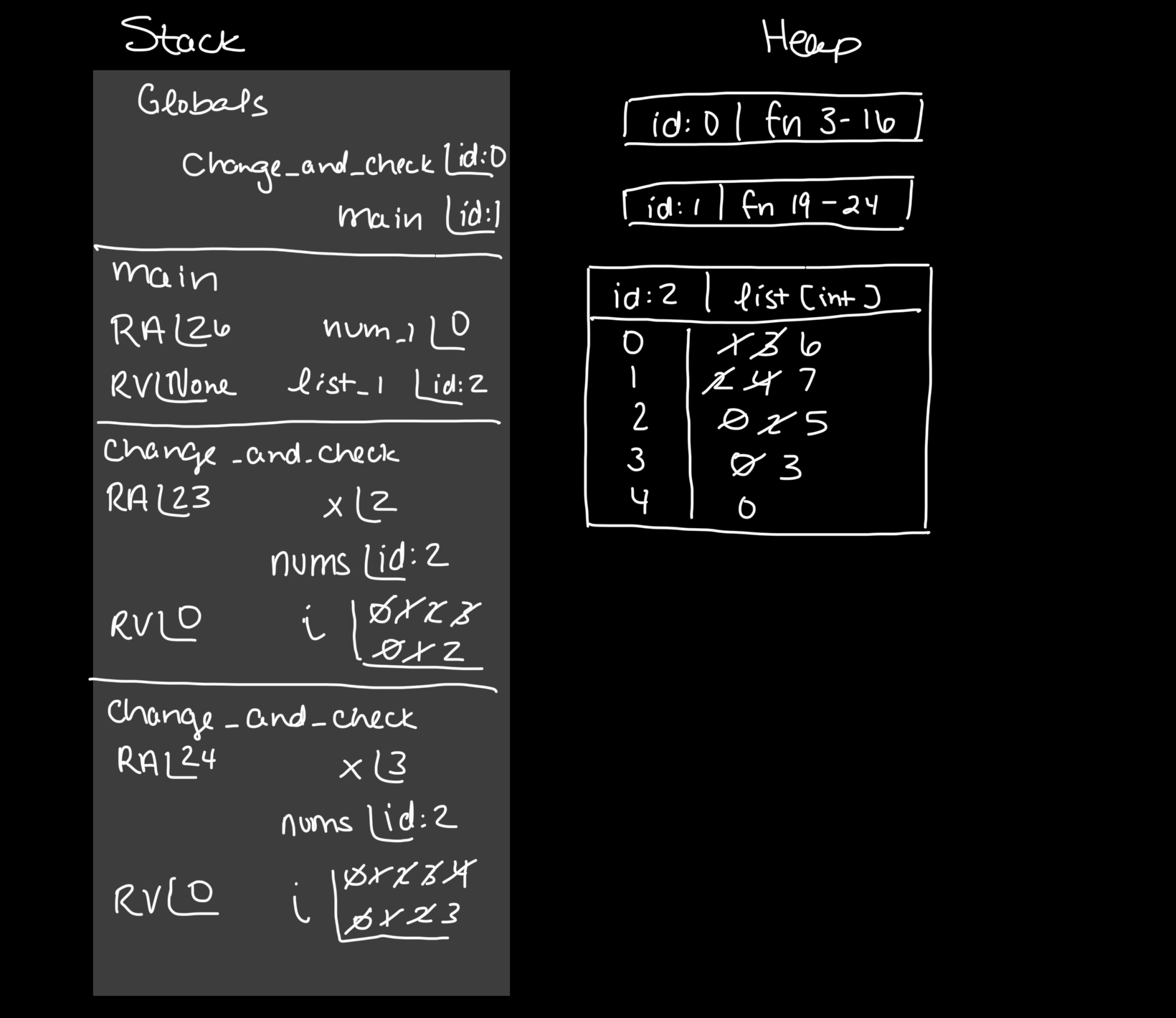
    """Practice diagram."""

    def change_and_check(x: int, nums: list[int]) -> int:
        """Let's see what happens!"""
        if x < 0:
            return 0
        i: int = 0
        while i < len(nums):
            nums[i] += x
            i += 1
        i = 0
        while i < len(nums):
            if nums[i] == x:
                return 0
            i += 1
        return x - 1


    def main() -> None:
        """The entrypoint of this program."""
        num_1: int = 0
        list_1: list[int] = [1, 2, num_1]
        list_1.append(change_and_check(2, list_1))
        list_1.append(change_and_check(3, list_1))

    main()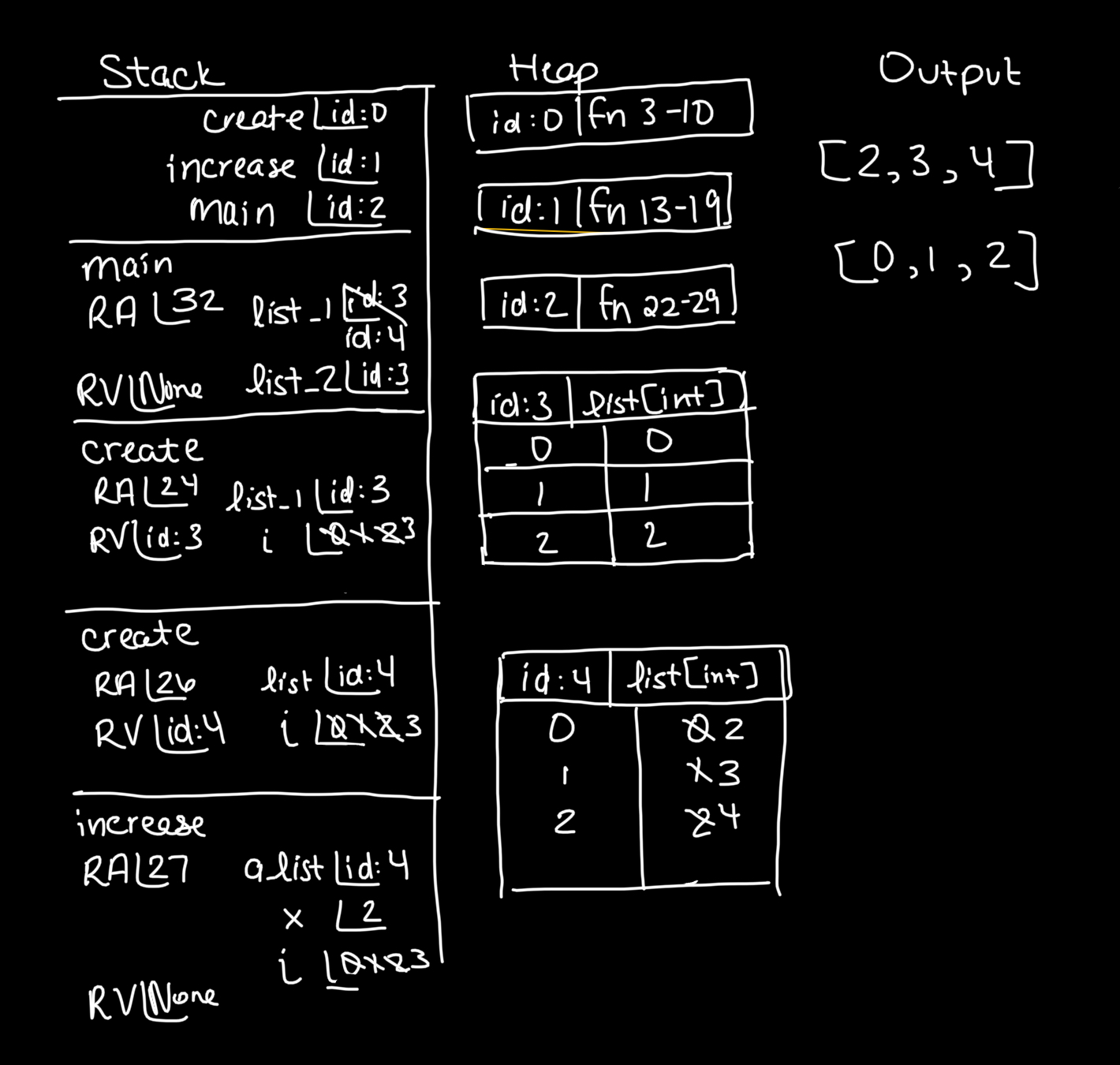
Dictionaries and for loops
- Create a memory diagram for the following code listing.
    def count(xs: list[int]) -> dict[int, int]:
        counts: dict[int, int] = {}
        for x in xs:
            if x in counts:
                counts[x] += 1
            else:
                counts[x] = 1
        return counts

    numbers: list[int] = [1, 1, 0]
print(count(numbers))- Create a memory diagram for the following code listing.
    """Practice diagram."""

    def artist_counts(playlist: dict[str, str]) -> dict[str, int]:
        artists: dict[str, int] = dict()
        for track in playlist:
            art: str = playlist[track]
            if playlist[track] not in artists:
                artists[art] = 1
            else:
                artists[art] += 1
        return artists

    songs: dict[str, str] = {
        "B2b": "Charli",
        "Hello": "Erykah",
        "Fiat": "Butcher",
        "Woo": "Erykah"
    }

print(artist_counts(songs))- Create a memory diagram for the following code listing.
    def f(x: dict[str,int]) -> int:
        for y in x:
            x[y] += 1
        return x[y]

    def g(x: dict[str,int]) -> dict[str,str]:
        new_dict: dict[str,str] = {}
        for z in x:
            new_dict[z] = str(z)
        return new_dict

    record: dict[str, int] = {"x": 20, "y": 40}
    print(f(record))
print(g(record))- Create a memory diagram for the following code listing.
    def mystery(x: dict[str,float], y: str) -> str:
        if y in x:
            return str(x[y])
        else:
            return "not in dictionary"

    x = "y"
    y = "z"
    test: dict[str,float] = {"z": 3.14}
print(mystery(test, y))- Create a memory diagram for the following code listing.
    """Practice diagram."""

    starting = dict[str, list[str]] = {}
    starting["2017"] = ["Berry", "Meeks", "Jackson"]
    starting["2023"] = ["Love", "Bacot", "Black"]

    print(starting["2017"][2])
    print(starting["2023"])
    starting["2023"][2] = "Johnson"
    print(starting["2023"])
SHOW SOLUTIONS
-
For just the answer, skip to 22:18 in the video linked above.
-
For just the answer, skip to 17:58 in the video linked above.
-
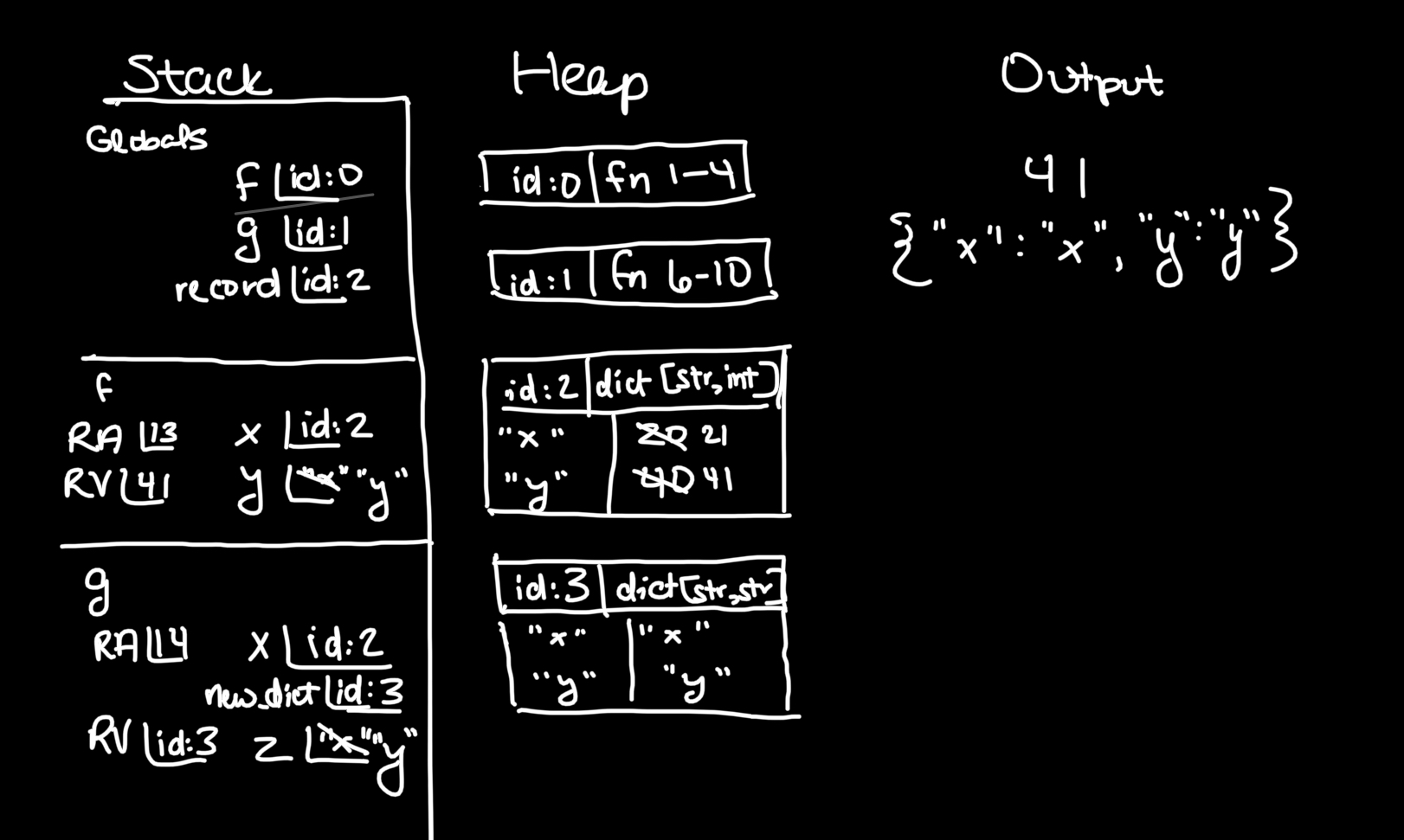
Image Description: The memory diagram is divided into three segments: Output, Stack, and Heap.
Under the stack, the Globals frame contains references to three objects:
- Function f points to a function on the Heap defined from lines 1 to 4.
- Function g points to a function on the Heap defined from lines 6 to 10.
- The variable record points to a dictionary object on the Heap with string keys and integer values.
The F frame has:
- Return Address (RA) at line 13.
- Return Value (RV) is the integer 41.
- Variable x points to a the same dictionary object on the heap as record.
- Variable y with a crossed-out value of “x” and updated to “y”.
The G frame has:
- Return Address (RA) at line 14.
- Variable x points to the same dictionary object as record.
- Variable new_dict to a second dictionary object on the Heap.
- Variable z with a crossed-out value of “x” updated to “y”.
The heap has two dictionary objects:
- The first dictionary object is associated with the variable record in Globals frame and the variable x in the F and G frames. It contains two string keys, ‘x’ with the integer value 20 crossed out and updated to 21, and ‘y’ with the integer value 40 crossed out and updated to 41.
- The second dictionary object is associated with the variable new_dict in the G frame, with string keys ‘x’ and ‘y’ and string values ‘x’ and ‘y’ respectively.
Output: The output displays the integer 41 and a dictionary object with keys ‘x’ and ‘y’, each paired with their respective values ‘x’ and ‘y’ as strings.
-
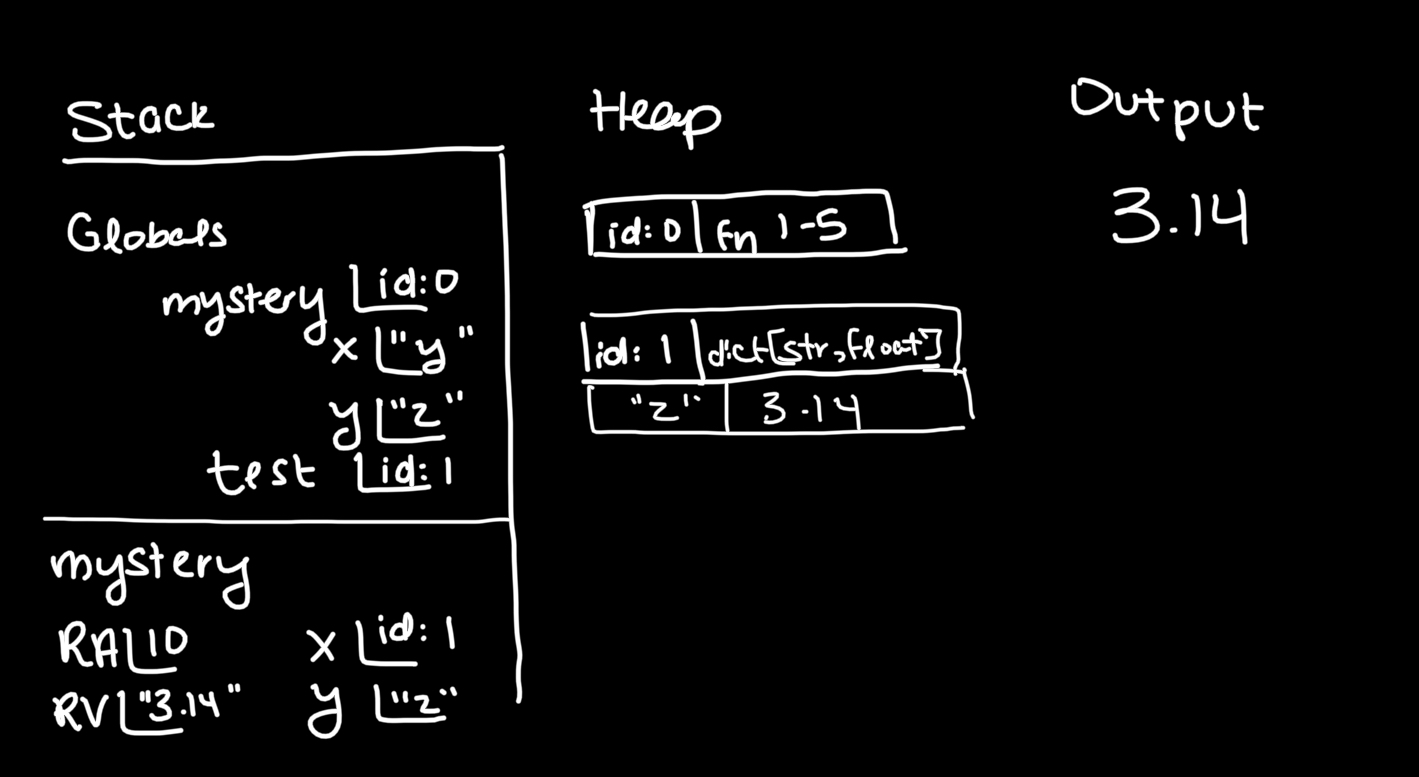
Image Description: The memory diagram provided displays elements in the Output, Stack, and Heap sections.
Stack:
The Globals frame contains three variables and a function:
- Function mystery points to a function definition on the Heap spanning lines 1 to 5.
- Variable x with the string value “y”.
- Variable y with the string value “z”.
- Variable test points to a dictionary on the Heap.
The mystery frame has:
- Return Address (RA) at line 10.
- Return Value (RV) is the string “3.14”.
- Variable x points to the same dictionary object as test
- Variable y has a value of “z”.
Heap:
- A dictionary object with string keys and a floating-point value is present. It contains a single entry where the key is the string “z” and the value is the floating-point number 3.14.
Output: The output section shows the floating-point number 3.14.
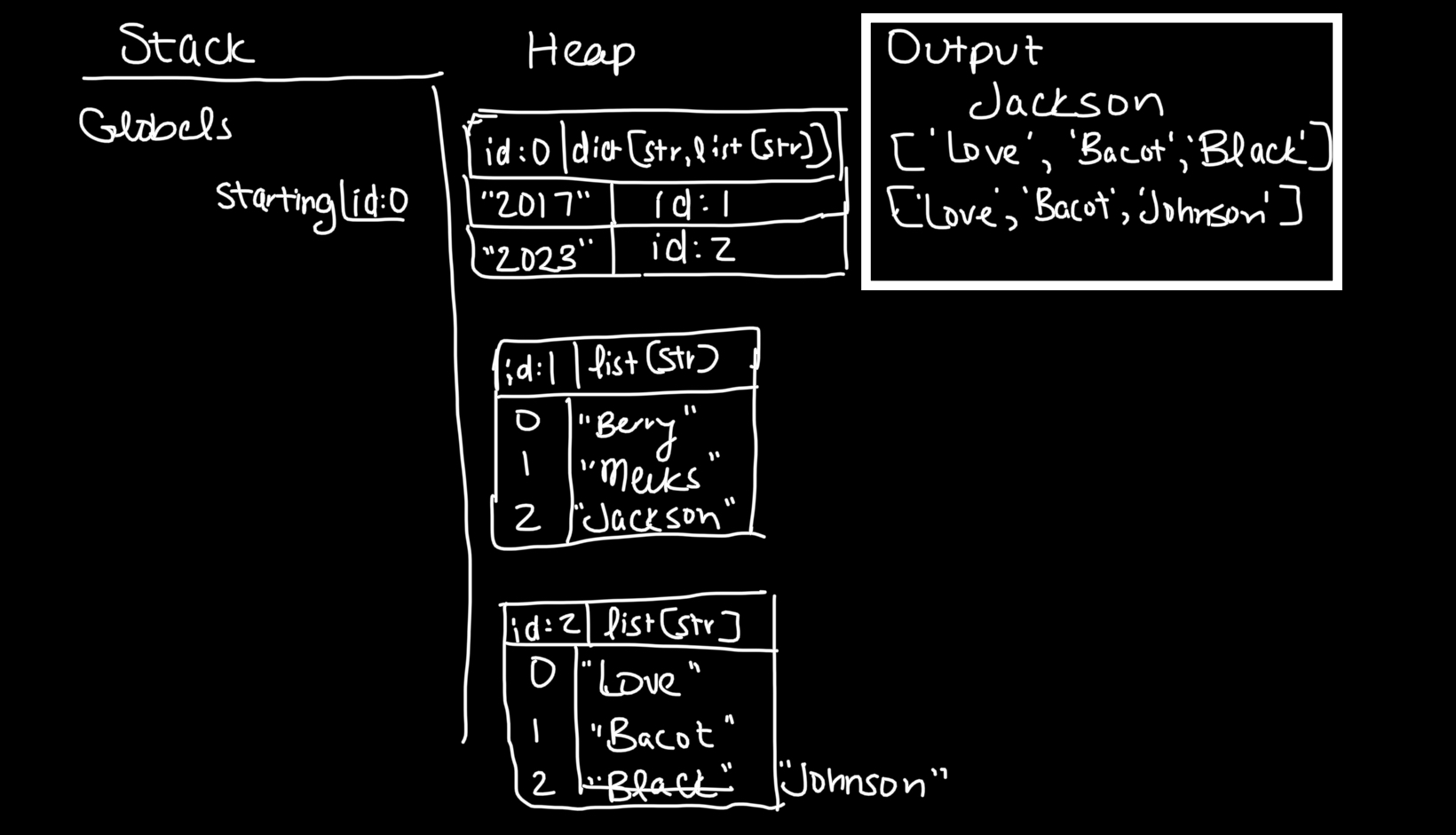
Image Description: The memory diagram provided contains three main components: Stack, Heap, and Output.
Stack: * The Stack section contains a single frame labeled “Globals.” * Inside Globals, there is a variable named starting pointing to a list on the Heap.
Heap: * The first part is a dictionary object with string keys and lists of strings for values. There are two keys: “2017” and “2023.” Each key points to a different list. * The second part consists of two lists of strings. Each list contains five elements with indices from 0 to 4. * The first list contains the following strings: “Berry”, “Meeks”, “Jackson”, “Pinson”, and “Hicks”. * The second list contains the strings: “Love”, “Bacot”, “Black”, “Johnson” (with “Nance” crossed-out), and “Davis”.
The output section has three outputs: * The string “Jackson” * The list [“Love”, “Bacot”, “Black”, “Nance”, “Davis”] * The list [“Love”, “Bacot”, “Black”, “Johnson”, “Davis”]