There are a lot of questions here, and if it feels like an overwhelming number, start with just a couple from each section that you think would help fill in any knowledge gaps you have.
If you find yourself feeling lost, please ask for help in office hours or tutoring.
Quiz 00 General Practice
Trace a memory diagram of the following code listing and answer the following subquestions.
    def total_price(calzones: int, strombolis: int) -> int:
        """Returns the total price for the order of food, including a service fee of $3."""
        return calzones_price(calzones=calzones) + strombolis_price(strombolis=strombolis) + 3

    def calzones_price(calzones: int) -> int:
        """Returns the price of the given number of calzones."""
        return 7 * calzones

    def strombolis_price(strombolis: int) -> int:
        """Returns the price of the given number of strombolis."""
        return 8 * strombolis

    print(total_price(calzones=4, strombolis=2))
1.1. What line(s) do function definition signatures appear on?
1.2. What line(s) do docstrings appear on?
1.3. What line(s) do expressions appear on?
1.4. What line(s) do function calls appear on?
1.5. Write a function call to
calzones_pricethat would evaluate to28.
SHOW SOLUTION
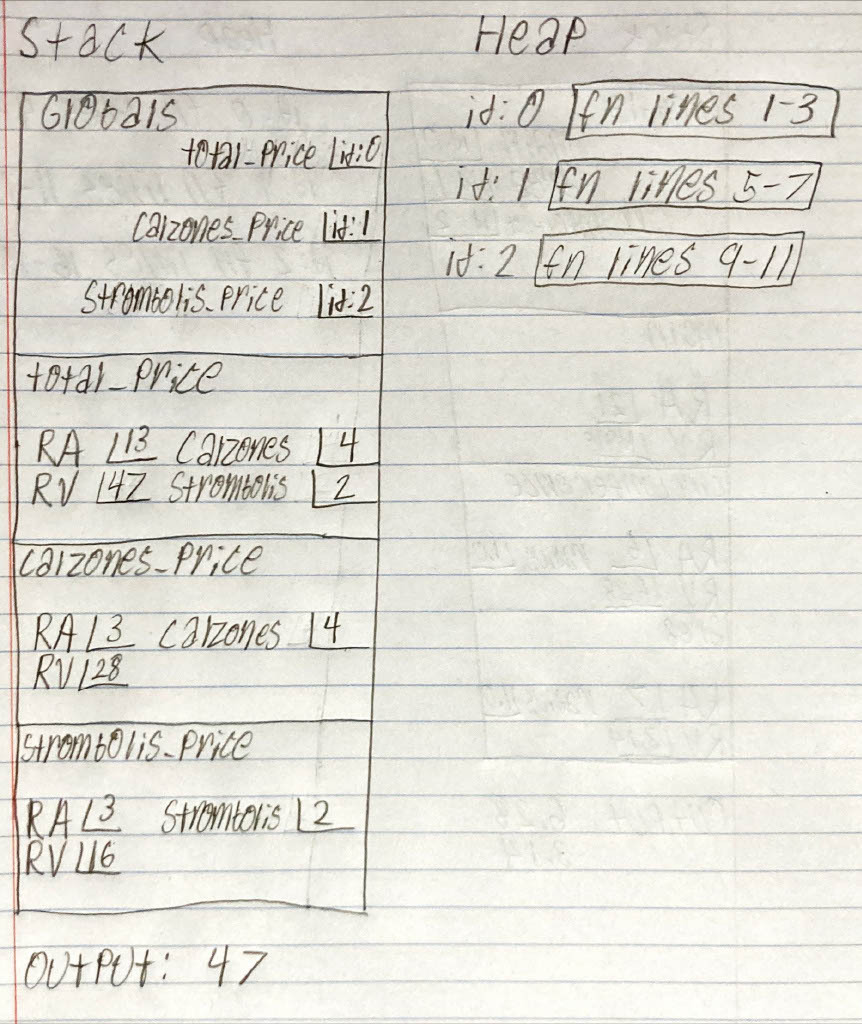
The correct answers are:
1.1. Lines 1, 5, and 9.
1.2. Lines 2, 6, and 10.
1.3. Lines 3, 7, 11, 13. Line 13 is a tricky one but it is a function call expression, thus an expression. The following explanation is intended for the curious, but is not required knowledge for the quiz:
You may not immediately think of a call to print() as being an expression because you may not know what it evaluates to (since all expressions must evaluate to a value). This is normal since that’s not really how we use print, but a function call expression to print() such as print("Hello!") evaluates to None. You can test this for yourself by going to your REPL and running the line print(print("Hello!")). This will result in two lines, first the inner print function call runs and Hello! will be printed out on the first line (with no quotation marks), then the outer print function call runs and prints the result of the function call expression print("Hello"), which is None, on the second line. Funky stuff!
1.4. Lines 3 and 13.
1.5. calzones_price(calzones=4)
Trace a memory diagram of the following code listing and answer the following subquestions.
    """Functions of a circle..."""


    def main() -> None:
        """Entrypoint of Program"""
        print(circumference(radius=1.0))
        print(area(radius=1.0))
        return None


    def area(radius: float) -> float:
        """Calculate area of a circle"""
        return 3.14 * radius ** 2


    def circumference(radius: float) -> float:
        """Calculate circumference"""
        return 2 * 3.14 * radius


    main()
2.1. What line(s) do function definition signatures appear on?
2.2. What line(s) do docstrings appear on?
2.3. What line(s) do expressions appear on?
2.4. What line(s) do function calls appear on?
2.5. What is the return type of
area? What is the return type ofmain?
SHOW SOLUTION
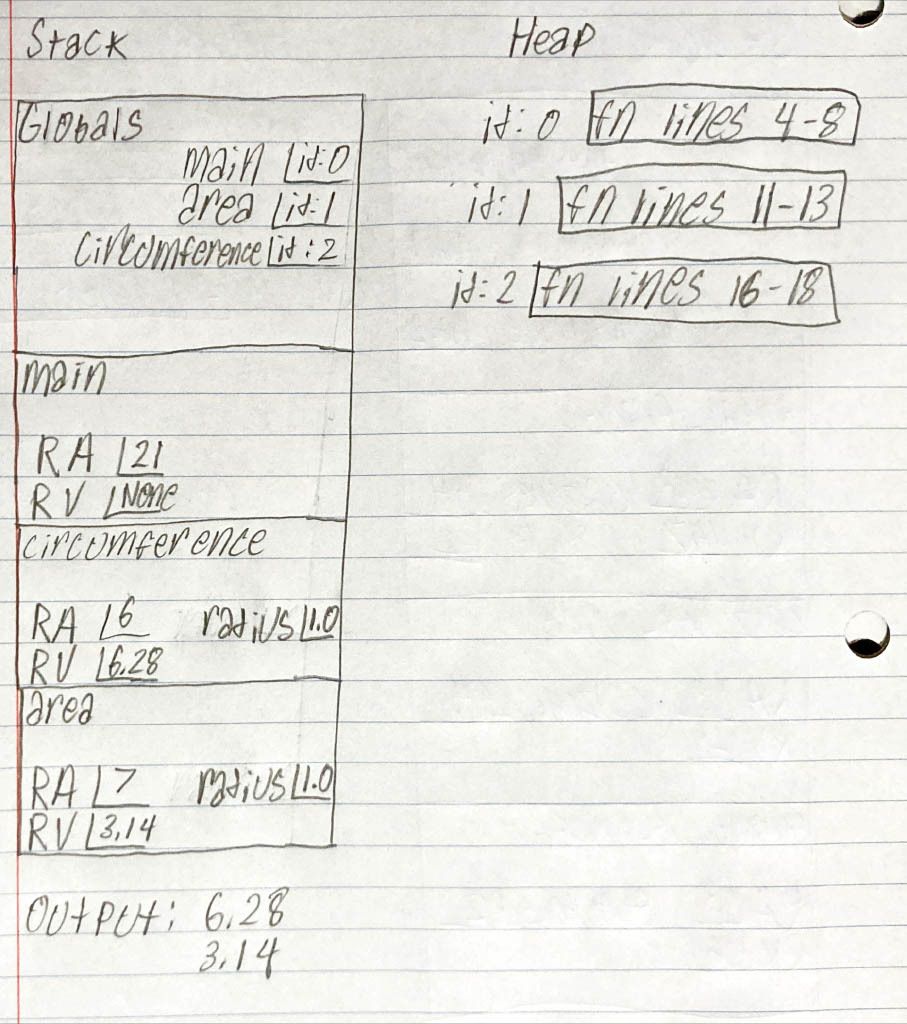
The correct answers are:
2.1. Lines 4, 11, and 16.
2.2. Lines 5, 12, and 17.
2.3. Lines 6, 7, 13, 18, and 21.
2.4. Lines 6, 7, and 21.
2.5. area has a return type of float and main has a return type of None.
- Trace a memory diagram of the following code listing.
    def big_func(a: int) -> int:
        return a + 2

    def bigger_func(b: int) -> int:
        return big_func(a=b) * 2

    def biggest_func(num: int) -> int:
        return bigger_func(b=num) ** 2

    def main() -> None:
        print(str(biggest_func(num=110)) + " is a big number!")

    main()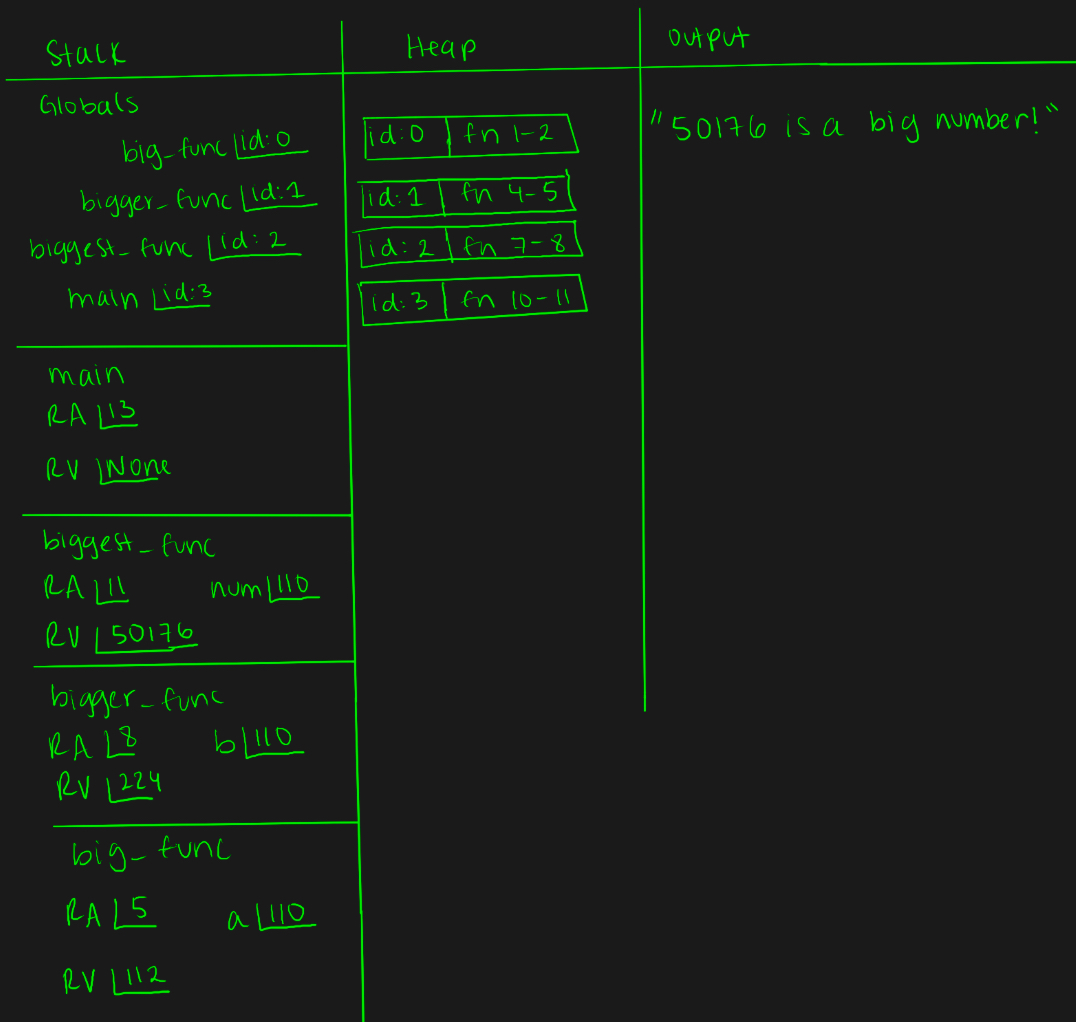
- Trace a memory diagram of the following code listing.
    def division(x: int, y: int) -> float:
        return y / x
        print(y % x)

    print(division(y=64, x=16))

    print(int(64/16))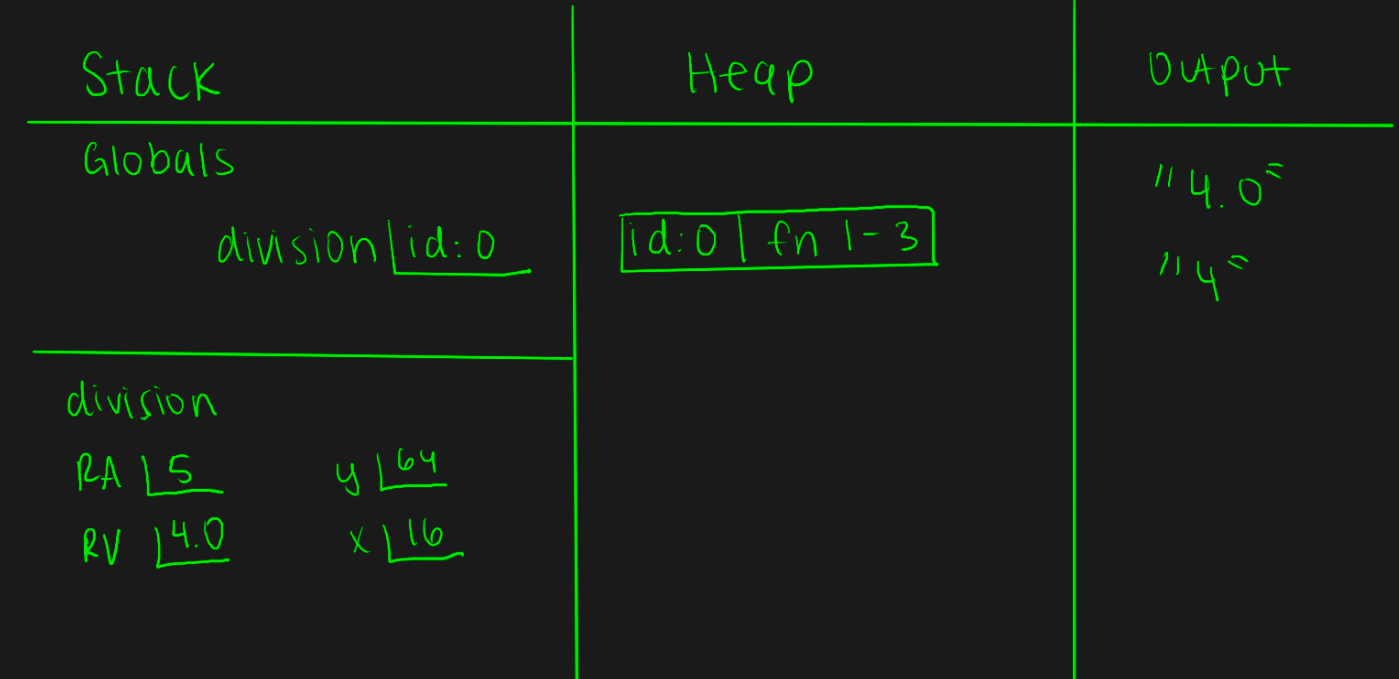
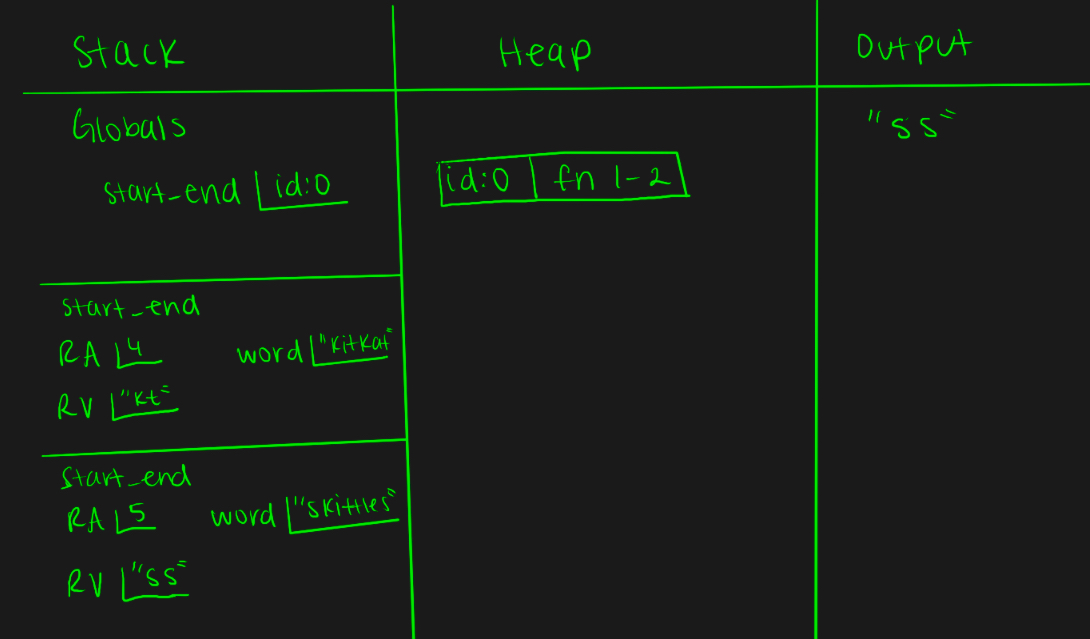
- Trace a memory diagram of the following code listing.
    def start_end(word: str) -> str:
        return word[0] + word[len(word)-1]

    start_end(word="kitkat")
    print(start_end(word="skittles"))
SHOW SOLUTION
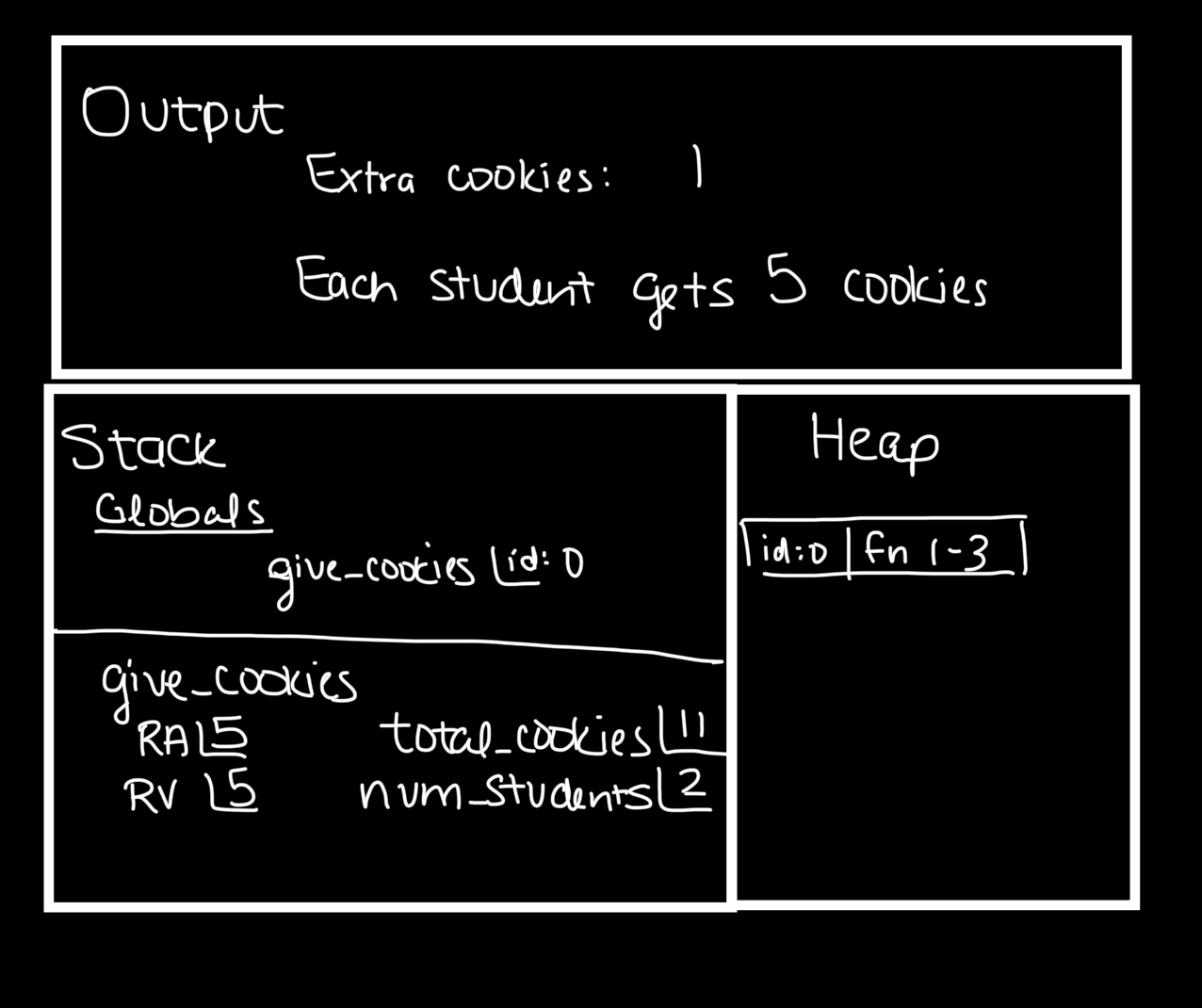
- Trace a memory diagram of the following code listing.
    def give_cookies(total_cookies: int, num_students: int) -> int:
        print("Extra cookies: " + str(total_cookies % num_students))
        return int((total_cookies - (total_cookies % num_students))/2)

    print("Each student gets " + str(give_cookies(total_cookies=11, num_students=2)) + "cookies")
SHOW SOLUTION
- Trace a memory diagram of the following code listing.
    def get_starting_point(word: str) -> int:
        return int(len(word) / 3)

    def shift_position(index: int) -> int:
        return index - 1

    def extract_character(word: str, index: int) -> str:
        return word[index]

    def main(word: str) -> None:
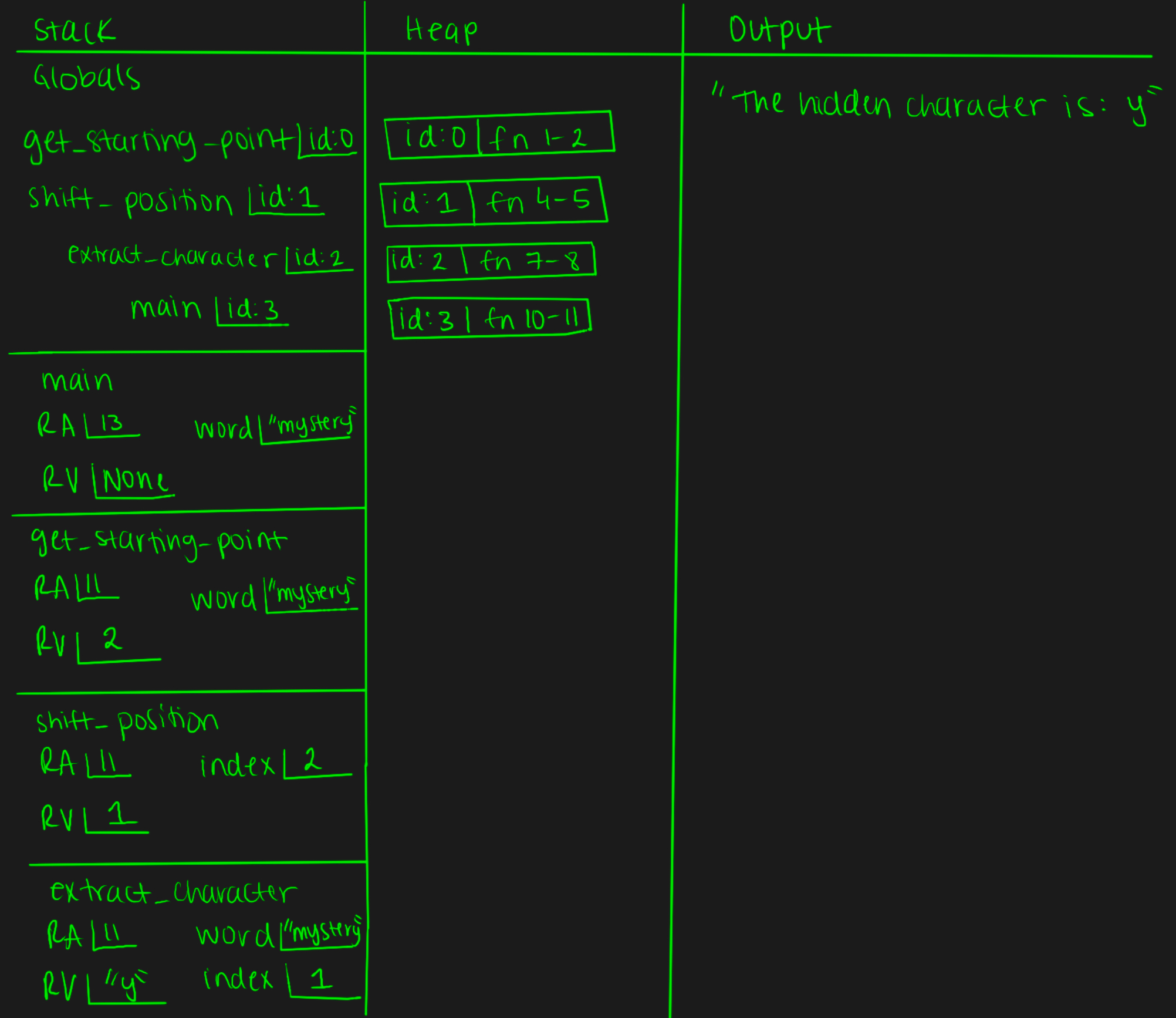
        print("The hidden character is: " + extract_character(word=word, index=shift_position(index=get_starting_point(word=word))))

    main(word="mystery")
SHOW SOLUTION